观前提醒
该文件为我个人自用的CLAUDE.md规则文件,维护生产项目已有一年时间,从 Cursor + opus 3.7 时代至现在Claude-Code + opus 4.6时代。
请注意:该文件也仅可用于 Claude code opus 4.6,我不是对 codex 和 gemini 有偏见,OpenAI 的 25k USD credits 今年6月份就要过期了,它(gpt-5.4-xhigh/codex-5.3-xhigh)要是真有自媒体和AI教父们宣传的那么牛逼plus,我能把这些credits放过保质期?
实测效果就是 codex 对函数式编程风格遵循不理想,对 opus 4.6 有效的简短提示词,你不掰开揉碎了讲给 AGENTS.md 它必定会跑偏。
因为编码风格,个人品味原因,请勿整段复制甚至替换掉你的规则文件。你可以让 Claude 阅读我的规则文件,分析后你再决定有哪些可以采纳,有哪些不适合你当前项目。我个人的编码和架构风格非常激进,因为许多代码/系统烂是烂在骨子里的,在这些屎山系统上打“优雅”的补丁实际上还是在推高屎山的海拔,而并没有真的降低技术债务。所以我的架构设计风格从来是大胆激进,没什么不能改也没什么不敢改的,活着的系统一定要经常重新审视,只要能降低技术债务,要敢于进行局部甚至底朝天的重写;只有死了的系统才是永恒不变的。
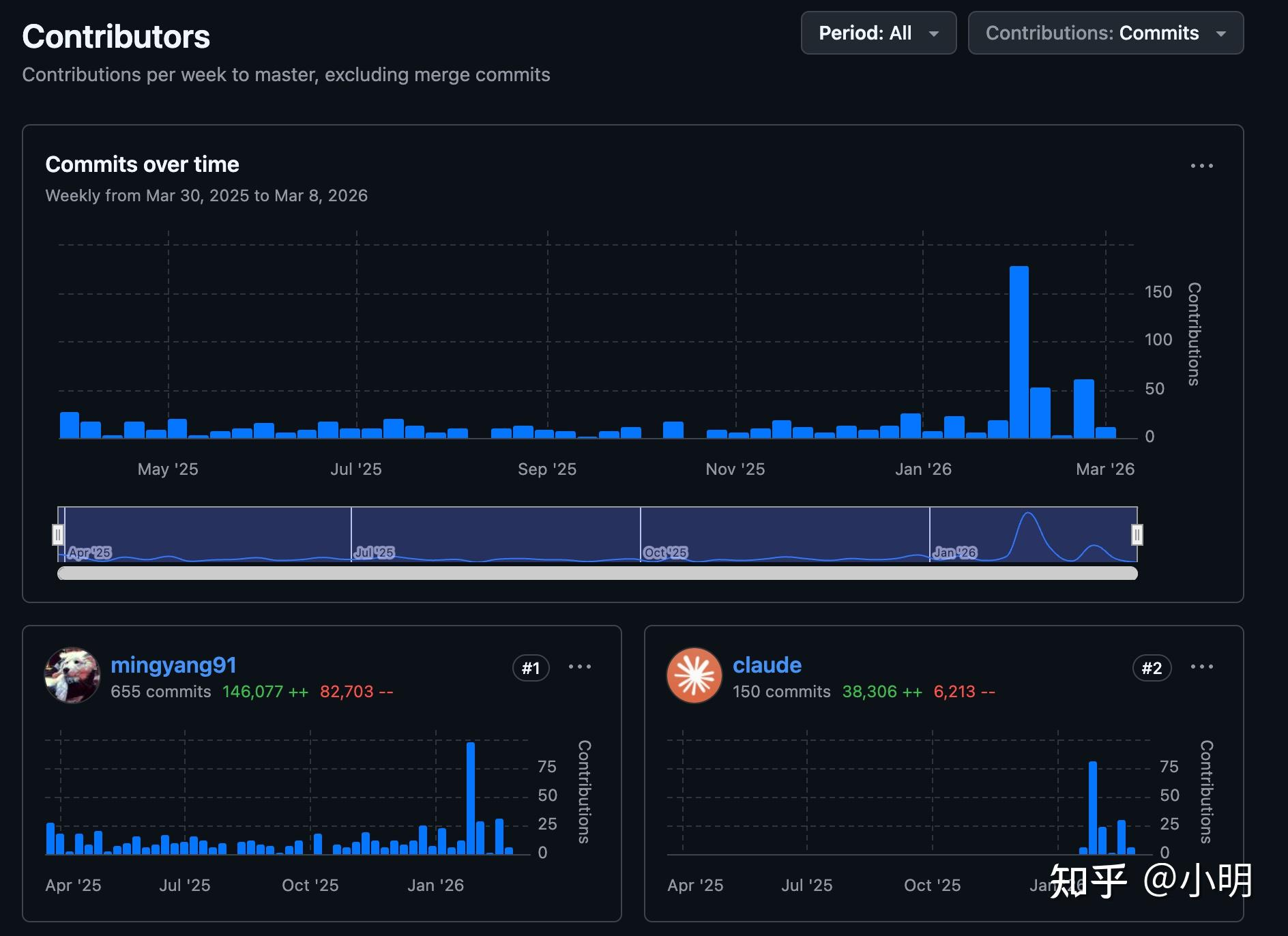
这是我的项目在 vibe 一年后的提交统计图,受到 opus 4.6 1M-context 的帮助,最近一个月我用 5k usd token 烧出了7-8 个超大型 feature 和从 Kotlin 到 Scala 的彻底重写,代码量也大幅降低到了3万行出头,系统健康程度远超半年前。
CLAUDE.md
This file provides guidance to Claude Code (claude.ai/code) when working with code in this repository.
Overview
Linewise API is a multi-tenant backend service built with http4s (Scala 3 / cats-effect). It provides document management, AI-powered features (embeddings, RAG), video SOP generation, and real-time communication capabilities.
Refactoring Philosophy
Prefer radical type-level refactors over conservative patches. This is a statically-typed Scala 3 codebase with tagless final — the compiler catches all downstream breakage. When fixing an issue, always choose the solution that encodes the constraint in the type system, even if it touches many files. A 15-file signature change that the compiler verifies is safer than a 1-file patch with a runtime check.
- Don’t minimize blast radius — maximize type safety. Changing a method from
List[T]toNonEmptyList[T]across 6 files is not “risky” — the compiler finds every call site. A runtime.toNel.gethidden in one file is the real risk. - The compiler is the last line of defense. If a refactor compiles, it’s correct. Treat compilation as the acceptance test for type-level changes.
- Write-cost is near zero. AI writes 90%+ of code, so the cost of touching more files is negligible. Optimize for correctness and compile-time safety, not for minimal diff.
- Type precision is not over-engineering. Over-engineering means unnecessary abstractions, config flags, strategy patterns for one implementation. Using
NonEmptyListoverList,ProjectIdoverUUID, or propagating constraints through signatures is the opposite — it removes complexity (runtime checks) by shifting it to the compiler. “Avoid over-engineering” applies to architecture, not to type-level precision.
Technology Stack
- Framework: http4s 0.23.33 (Ember server)
- Language: Scala 3.8.1
- Runtime: Java 25 (Amazon Corretto)
- Build: Mill 1.1.2
- Database: PostgreSQL 42.7.3 + pgvector extension + ltree extension
- ORM: Doobie 1.0.0-RC11
- Auth: Firebase Admin SDK 9.4.3
- AI: Google Cloud Vertex AI (embeddings, GenAI, RAG), Google GenAI SDK
- Migrations: Flyway 11.7.2
- Scheduler: Quartz 2.5.0
- Observability: otel4s 0.15.0 (OpenTelemetry), Sentry error tracking
- Container Orchestration: Optional Kubernetes integration for video processing jobs
Build & Run Commands
| |
Database setup:
| |
Project Structure
src/main/scala/io/linewise/
├── LinewiseApp.scala           # Main entry point (IOApp.Simple)
├── core/                       # Shared infrastructure
│   ├── auth/                   # Firebase auth, claims parsing
│   ├── config/                 # AppConfig (pureconfig HOCON)
│   └── database/               # Doobie transactor, multi-tenant, Flyway
├── features/                   # Feature modules
│   ├── bookmark/               # Bookmark management
│   ├── chat/                   # Chat sessions
│   ├── copy/                   # Content copy
│   ├── document/               # Document CRUD, embeddings, GCS
│   ├── folder/                 # Folder management
│   ├── librechat/              # LibreChat integration
│   ├── mfareset/               # MFA reset
│   ├── permission/             # Resource-scoped permissions
│   ├── project/                # Projects, membership, RBAC
│   ├── quota/                  # Usage quota tracking
│   ├── rag/                    # RAG indexing & retrieval (pgvector)
│   ├── reindex/                # Reindex jobs
│   ├── settings/               # System/tenant settings
│   ├── sop/                    # SOP generation (video → steps)
│   ├── system/                 # Tenant admin endpoints
│   ├── transcode/              # Video transcoding
│   ├── user/                   # User profiles & preferences
│   ├── video/                  # Video clips, descriptions, fingerprints
│   └── webauthn/               # WebAuthn/passkeys
├── http/                       # HTTP layer
│   ├── routes/                 # Route handlers
│   ├── AuthMiddleware.scala
│   └── ErrorHandlingMiddleware.scala
├── infrastructure/             # External integrations
│   ├── firebase/               # Firebase auth & email
│   ├── ffmpeg/                 # FFmpeg wrapper
│   ├── gcs/                    # Google Cloud Storage
│   ├── genai/                  # Gemini video analysis
│   ├── kubernetes/             # K8s job delegation
│   ├── sentry/                 # Error tracking
│   ├── telemetry/              # otel4s tracing
│   ├── videointelligence/      # Video Intelligence API
│   ├── videoseal/              # Neural watermarking
│   └── vertexai/               # Vertex AI, MCP server (30 tools)
└── jobs/                       # Quartz job schedulers
Configuration
Main config: src/main/resources/application.conf (HOCON format, parsed by pureconfig)
Environment Variables:
DATABASE_URL- PostgreSQL JDBC URL (orsecrets/database/urlfile)JWT_SECRET- JWT signing secret (fallback: “linewise”)GCS_BUCKET- GCS bucket for documents (fallback: “linewise-documents”)GCS_HOSTNAME- Optional GCS hostnameTRANSCODE_GCS_BUCKET- GCS bucket for transcoded videos (fallback: “linewise-transcode”)TRANSCODE_GCS_HOSTNAME- Optional transcode GCS hostnameENABLE_OTEL- Enable OpenTelemetry (fallback: false)SENTRY_DSN- Sentry error tracking DSN (optional)SENTRY_ENV- Sentry environment (fallback: “development”)KUBERNETES_JOBS_ENABLED- Enable K8s job delegation for video processing (fallback: false)KUBERNETES_NAMESPACE- K8s namespace for jobs (fallback: “default”)FIREBASE_API_KEY- Firebase API key (for MCP browser login)FIREBASE_AUTH_DOMAIN- Firebase auth domain (for MCP browser login)
Required secrets (excluded from VCS):
secrets/firebase/service-account.json- Firebase Admin SDK credentialssecrets/gcp/service-account.json- GCP service account for Vertex AIsecrets/database/url- PostgreSQL JDBC URL (optional, defaults to localhost)
Key Architectural Patterns
Tagless Final Pattern
The codebase uses tagless final with context bounds for dependency injection:
| |
NoOp Result Patterns:
NoOp implementations are used for: (a) test runners / local partial testing, and (b) feature-flag-disabled services in LinewiseApp.scala. NoOp returns results (not throw exceptions). The caller decides if it’s an error.
Data-related vs data-unrelated services:
- Data-related (RAG, video processing, document ops, SOP): NoOp must return error (
Left("Service not available")).Optionmethods returnNone— but note this means “not found”, which is semantically different from “service disabled”. ForEither-returning methods (create, update, delete), always returnLeftso the caller knows the operation was not performed. Data-related services should useF[Either[E, T]]by default (notF[T]orF[Option[T]]for mutation), because they involve the persistence layer which can fail. - Data-unrelated (logging, metrics, telemetry): NoOp can return success (
Right(())). Skipping side-effect-only operations is harmless.
| |
Method-level context bounds for partial dependencies:
When only some methods on a service need an extra capability, use a method-level using parameter instead of requiring it on the whole class:
| |
Wiring with givens in LinewiseApp:
| |
Code Style: Flat for-comprehensions
Prefer flat for/yield over nested match/case inside effectful blocks. Lift Either/Option into F so the for stays linear:
| |
Key lifters:
EitherT(...).foldF—F[Either[E, A]]→ handle both branchesEitherT.fromOptionF—F[Option[A]]→EitherT[F, E, A].subflatMap— pureA => Either[E, B]inside EitherT chain.semiflatMap— effectfulA => F[B]on happy pathOptionT(...).semiflatMap(...).getOrElseF(...)—F[Option[A]]→ handle NoneSync[F].fromEither,Sync[F].fromOption— lift pure values (throw on error)
No premature helpers: Don’t extract single-use private methods that just wrap a match. Inline the logic at the call site.
Case classes over manual cursor decoding: For external API payloads, define case classes with derives Decoder and decode once with .as[T], then pattern-match on decoded fields. Avoid manual hcursor.downField(...).get[T](...) chains.
SDK/Library Priority Order
When integrating external services (e.g., Google Cloud, AWS, Firebase), prefer libraries in this order:
- Typelevel-wrapped Scala SDK (e.g., from typelevel.org ecosystem)
- Native cats-effect integration, functional patterns
- Official Scala SDK (e.g., from Google/Azure/AWS)
- First-party support with Scala idioms
- Third-party wrapped Scala SDK (actively maintained)
- Community wrappers with Scala-friendly APIs
- Official Java/Kotlin SDK (wrap with
Async.blocking)- Use when no Scala alternative exists
- Implement yourself (HTTP client)
- Last resort, only when SDK unavailable or unsuitable
Example: For Google Gemini integration, use the official Java SDK wrapped with Async[F].blocking rather than implementing raw HTTP calls.
Multi-Tenancy with Schema Isolation
The database uses PostgreSQL schema isolation for multi-tenancy:
- System schema (
public): Stores shared data (tenants, users, system settings, quotas) - Tenant schemas (
tenant_<id>): Each tenant gets an isolated schema for their data (projects, documents, SOPs, etc.)
Migration System:
- System migrations:
db/migration/system/- run once at startup - Tenant migrations:
db/migration/tenant/- run for each tenant schema - Migrations run automatically at startup for all existing tenants
- New tenant schemas are migrated on creation
- Never modify existing migration files; always create new versioned files
Tenant Schema Access:
All tenant routes follow the pattern: /api/org/{tenant}/...
Fail Fast - No Silent Error Swallowing
CRITICAL RULE: Never silently swallow errors. Arbitrary tolerance pollutes the database and hides bugs.
Forbidden patterns:
| |
Error Handling Strategy - Trusted vs Untrusted Paths:
| Path Type | Examples | Strategy |
|---|---|---|
| Trusted (internal) | Config files, system settings, DB schema data, internal serialization, persisted DB data, internal service calls, cache, GCS/K8s metadata | Throw exception - low probability of error, if it fails it’s a bug. For infra (GCS/K8s), human runs data migration after code changes. |
| Untrusted (external) | User input, AI-generated content, external API responses (before persistence) | Catch and report - high probability of error, report back to user/AI to fix |
Persisted data is trusted. Strict enc/dec at the write boundary ensures bad-format data never reaches the DB. If malformed data is read back from DB, it’s a human/migration bug — throw, don’t defensively handle.
| |
Typed Error Model (ADT Errors)
Use enum error types, not Either[String, T]. Services define sealed error enums for known failure modes. Routes pattern-match on the enum to decide HTTP status — no string parsing.
Scope: one error enum per logical failure domain, not per service.
- If two methods share most failure modes → one shared enum
- If two methods have different failure modes → separate enums
- Shared subset across domains → compose via wrapping:
ParseError.Embedding(EmbeddingError)
| |
Rules:
- Named variants for known failures. Each variant carries structured context (IDs, limits, types), not string messages.
Sdk/Other(message: String)variant for unexpected errors that don’t warrant their own case yet.- Compose, don’t flatten. When service A calls service B, wrap B’s error:
case Embedding(cause: EmbeddingError), notcase EmbeddingFailed(message: String). - Route mapping: Each error variant maps to exactly one HTTP status. The match is exhaustive — compiler enforces handling every variant.
- Define in feature’s
models.scala. - Migrate when file is touched — no hesitation. New services use typed errors. Existing
Either[String, T]services migrate the whole service to ADT errors when the file is modified for any reason — even a typo fix or comment edit. The trigger is touching the file, not the size of the change. Touching the file means QA/regression testing covers it, making it the perfect time. Scope follows the compiler iteratively — if the route file you’re editing calls a service withEither[String, T], migrate that service file too.
Feature Module Organization
Each feature module follows a consistent structure:
features/<feature>/
├── <Feature>Service.scala      # Business logic (tagless final trait + impl)
├── <Feature>Repository.scala   # Data access layer (Doobie queries)
├── models.scala                # Domain objects and DTOs
└── README.md                   # Feature documentation
Layered Architecture:
Routes → Services → Repositories → Database (Doobie)
   ↓         ↓            ↓
  DTOs   Business    SQL Queries (ConnectionIO)
        Logic
Testing Strategy
Tests use:
- munit with cats-effect support for test framework
- TestContainers for PostgreSQL integration tests (automatic database provisioning)
- Doobie munit for query checker tests
What NOT to test (waste of time):
- Case classes - no value without complex methods
- JSON serialization - Circe is already well-tested
- Config class definitions - if config is wrong, app fails to start anyway
- Framework behavior (http4s, Doobie) - already well-tested by the community
What TO test (valuable):
- Security validation (e.g., tenant name injection prevention)
- Error handling / fallback logic
- Real database integration with TestContainers
- Business logic that has actual branching/computation
- Assembly/wiring that connects our components together
API Routes
All routes require Firebase JWT auth:
/api/org/{tenant}/projects/- Project management/api/org/{tenant}/projects/{id}/documents/- Document CRUD/api/org/{tenant}/projects/{id}/sops/- SOP management/api/org/{tenant}/projects/{id}/bookmarks/- Bookmarks/api/system/tenants/- Tenant admin/api/system/users/- User management
Tool Preferences
Override Grep with Metals MCP when the question is “what does the compiler resolve this to?”
Grep is the default and works for most searches. But it fails silently on these Scala-specific scenarios — use Metals instead:
| Scenario | Tool |
|---|---|
| What type is this expression / what does it return? | mcp__metals__inspect |
| Which given/implicit is resolved at this call site? | mcp__metals__inspect |
| Which overloaded method is called here? | mcp__metals__inspect |
| What’s the underlying type of an opaque type? | mcp__metals__inspect |
| What does a wildcard import bring into scope? | mcp__metals__inspect |
| Who calls this method / all implementations of a trait? (semantic, not textual) | mcp__metals__get-usages |
Other Metals tools: glob-search (find symbols by name), get-docs (ScalaDoc), compile-file (single-file compile check), list-modules, list-scalafix-rules.
Signal to switch: When you grep and get 10+ candidates with no way to disambiguate — that means you need Metals, not a better regex. Fall back to Grep/Glob for non-Scala files, string literals, config values, SQL, or when Metals is unavailable.
Development Workflow
Adding New Routes
When adding or modifying routes:
- Update the OpenAPI spec: After route/DTO changes, update
src/main/resources/openapi/documentation.yaml - Validate the spec: Run
swagger-cli validateto ensure correctness - Follow authentication patterns: All API routes require Firebase JWT authentication (except system/health endpoints)
Code Formatting
Use scalafmt (configured in .scalafmt.conf):
| |
Code style rules:
- No fully-qualified names in code. Always use imports.
- Context bounds: use
{A, B, C}syntax (Scala 3.6 aggregate bounds), not colon-separated. - Opaque types for domain values. AI writes 90%+ of code, so write-cost is near zero while compile-time safety is free. Use opaque types with smart constructors for all entity IDs, constrained strings, and bounded numbers. Defined in
core/domain/Ids.scalaandcore/domain/Types.scala. - Type-level constraints flow E2E. Encode invariants in types (opaque types,
NonEmptyList, refined types) and propagate them through all layer signatures: route → service → repository. Never downgrade a constraint to a weaker type and re-validate internally — that hides the requirement from callers and defeats compile-time safety. Unwrap/weaken only at the true system boundary: SQL interpolation, Java SDK calls, job parameter serialization. .toStringover.value.toString. Opaque types erase at runtime, sos"...$opaqueId"andopaqueId.toStringjust work — no need to unwrap first.NonEmptyListoverList+.get/.head. When a method logically requires non-empty input (batch embeddings,INclauses, etc.), useNonEmptyList[T]in the signature — including repository methods — instead ofList[T]with a runtime.toNel.getor.head. Callers useNonEmptyList.fromListto handle the empty case at the call site.- No premature helpers. If the logic can be composed from <5 Scala/cats operators, always inline at call site — never extract a helper. If >=5 operators, ask the user before extracting (in plan mode or popup dialog). When consensus is reached on a new helper, add/link it in this document so future sessions know to use it. Always use helpers already listed here (e.g.,
AsyncOps) — don’t expand them inline. Before writing any new helper, search the codebase for existing ones that do the same thing. - Generic over specific (stdlib/cats only). Prefer composing well-tested Scala/cats operators generically (one
queryParam[T]usingQueryParamDecoder[T]) over type-specific parsers. “Generic” means leveraging stdlib type classes, not extracting custom helper functions — those still follow the <5 operator rule. - Proactive naming review. When modifying code, flag misleading, stale, or inconsistent names to the user. Scope follows the compiler iteratively — same as smell detection: start with changed files, then follow compilation errors outward. For internal names (classes, properties, methods) — recommend renaming directly. For external names (request/response DTOs, DB-serialized JSONB fields) — suggest the better name but note migration implications. Common smells: Kotlin-era suffixes (
Kt), field names that don’t match their type (nameholding an ID), stale comments referencing deleted code, generic names that obscure domain meaning. - Proactive code smell detection. Scope follows the compiler iteratively: (1) find smell in current file, (2) fix it, (3) compile → if it fails because other files import the changed symbol, fix those too, (4) repeat until compilation passes. If reading unrelated code (not in the compilation chain) and spotting a violation — add it to the smell list (see Code Smell Tracking below), do not fix. This applies to all rules: type safety, error handling, control flow, naming, logging, etc.
Code Smell Tracking
When spotting code smells in unrelated code (not in the current compilation chain), add them to the persistent smell list file at <project-root>/memory/code_smells.md instead of just warning in the response.
Rules:
- Max 10 entries. If adding an 11th, delete the oldest entry (FIFO eviction).
- Prioritize by severity. Most critical smells first (silent error swallowing > naming inconsistency).
- At end of every task, remind the user about pending smells and suggest fixing them in a dedicated session.
- Each entry includes: file path, line number, rule violated, brief description.
- Remove entries when the smell is fixed (either by the user or in a subsequent session).
Logging
- Use
val logger(not context-bound injection). Create a localval logger = Slf4jLogger.getLogger[F]or pass as constructor param. Logger is too common to justify tagless-final injection overhead. - Milestone logging for long operations. Every long-running call (external API, DB migration, video processing, embedding) should log at each major step so operators can see progress and diagnose hangs.
- Log level in loops: If each iteration is fast (e.g., processing a list of items), use
debug/trace. If each iteration is slow (e.g., transcoding, embedding backfill),infois appropriate. - Log levels:
error= unexpected failures that need attention.warn= degraded but recoverable.info= lifecycle events, milestones, external calls.debug= per-item processing in loops, internal state.
Runtime Assertion Checks (RAC)
Suggest runtime assertions on critical paths (advisory, not mandatory). RACs catch inconsistent state early, before it propagates downstream and corrupts data. Always enabled in dev/testing; switchable off in production via config flag. Final decision on whether to add RAC is made during code review — do not treat missing RAC as a code smell.
Implementation: Use the shared RAC.assert(condition, message) helper (io.linewise.core.RAC) that checks a config flag. When disabled, assertions are no-ops. When enabled, they throw immediately.
What should have RAC:
- Money/balance operations — assert balance >= 0 after debit, assert credit + debit = expected total
- Inconsistent state transitions — assert valid transitions in state machines (e.g., SOP stage: draft→processing→published, never published→draft; RAG index: PENDING→INDEXING→INDEXED, never backward). Throw immediately on invalid transition to prevent downstream pollution.
- Tenant isolation — assert search_path matches expected tenant schema before writes. Wrong schema = cross-tenant data leak.
- Embedding dimensions — assert vector length matches expected dimension (768 for text, 1408 for video) before pgvector insert. Wrong dimension corrupts similarity search silently.
- Idempotency — assert no duplicate job submission for same entity (K8s jobs, Quartz jobs). Duplicates waste resources.
- Invariant preservation — any operation where a post-condition violation would silently corrupt data rather than fail visibly.
What should NOT have RAC:
- Input validation (use typed errors instead — that’s user-facing, not assertion)
- Performance-sensitive hot loops (use debug logging instead)
- Conditions already enforced by the type system (that’s the compiler’s job)
CI/CD Pipeline
IMPORTANT: Do NOT build and push Docker images from local machine. Always commit and push to git to trigger CI for building images. Only build locally if explicitly requested by the user.
Branches and Docker Tags:
developbranch →gcr.io/${PROJECT_ID}/linewise-api:developtestingbranch →gcr.io/${PROJECT_ID}/linewise-api:testingmasterbranch →gcr.io/${PROJECT_ID}/linewise-api:latestand:master- Git tag
vX.Y.Z→gcr.io/${PROJECT_ID}/linewise-api:vX.Y.Z
Git Push:
- If SSH push fails (e.g. VPN/proxy blocks port 22), switch to HTTPS temporarily:
git remote set-url origin https://github.com/Vision-Nexus/linewise-api.git
Deployment:
- GitHub Actions workflow:
.github/workflows/build-and-push-gcr.yml - Builds with Mill, then Docker image, pushes to Google Container Registry
- Requires
GCR_SERVICE_ACCOUNTsecret (GCP service account JSON) - Deployed via ArgoCD on Kubernetes (not docker-compose or manual shell)
- Deploy manifests live in a separate repo:
linewise-deploy/overlays/{dev,testing,prod}
Deploy impact reporting: When a code change involves deploy-affecting changes, output a summary of what needs to be updated in the deploy repo. Examples:
- New environment variable → add to ConfigMap or Secret in the overlay, reference in Deployment env
- New configuration field → add to
application.confConfigMap - New sidecar container → add container spec to Deployment manifest
- New volume/secret mount → add Volume + VolumeMount to Deployment
- New external service dependency → may need NetworkPolicy, ServiceAccount, or IAM binding
Format the output as a checklist the user can apply to the deploy repo. Do NOT suggest docker-compose changes or manual docker run / kubectl apply commands.
Key Dependencies & Services
External Services Integration
- Firebase Admin SDK: User authentication and JWT verification
- Vertex AI: Text embeddings, Gemini models, Document AI for OCR
- Google Cloud Storage (GCS): Document and video file storage
- LibreChat: Optional integration for chat interface
Optional Features
Kubernetes Job Delegation:
- Video processing (FFmpeg, VideoSeal) can run as K8s jobs instead of in-process
- Enable via
KUBERNETES_JOBS_ENABLED=true - Requires service account with GCS access and K8s job permissions
Observability:
- otel4s: Native Scala OpenTelemetry integration (set
ENABLE_OTEL=true) - Sentry: Error tracking and monitoring (provide
SENTRY_DSN)
Important Files
LinewiseApp.scala- Main entry point, service initialization, givens wiringbuild.mill- Mill build definition, dependenciesapplication.conf- HOCON configuration with environment variable overridesDockerfile- Multi-stage build with Mill, FFmpeg for video processingdocker-compose.yaml- Local PostgreSQL with pgvector for development